Western vs Vedic Zodiac Dates Explained
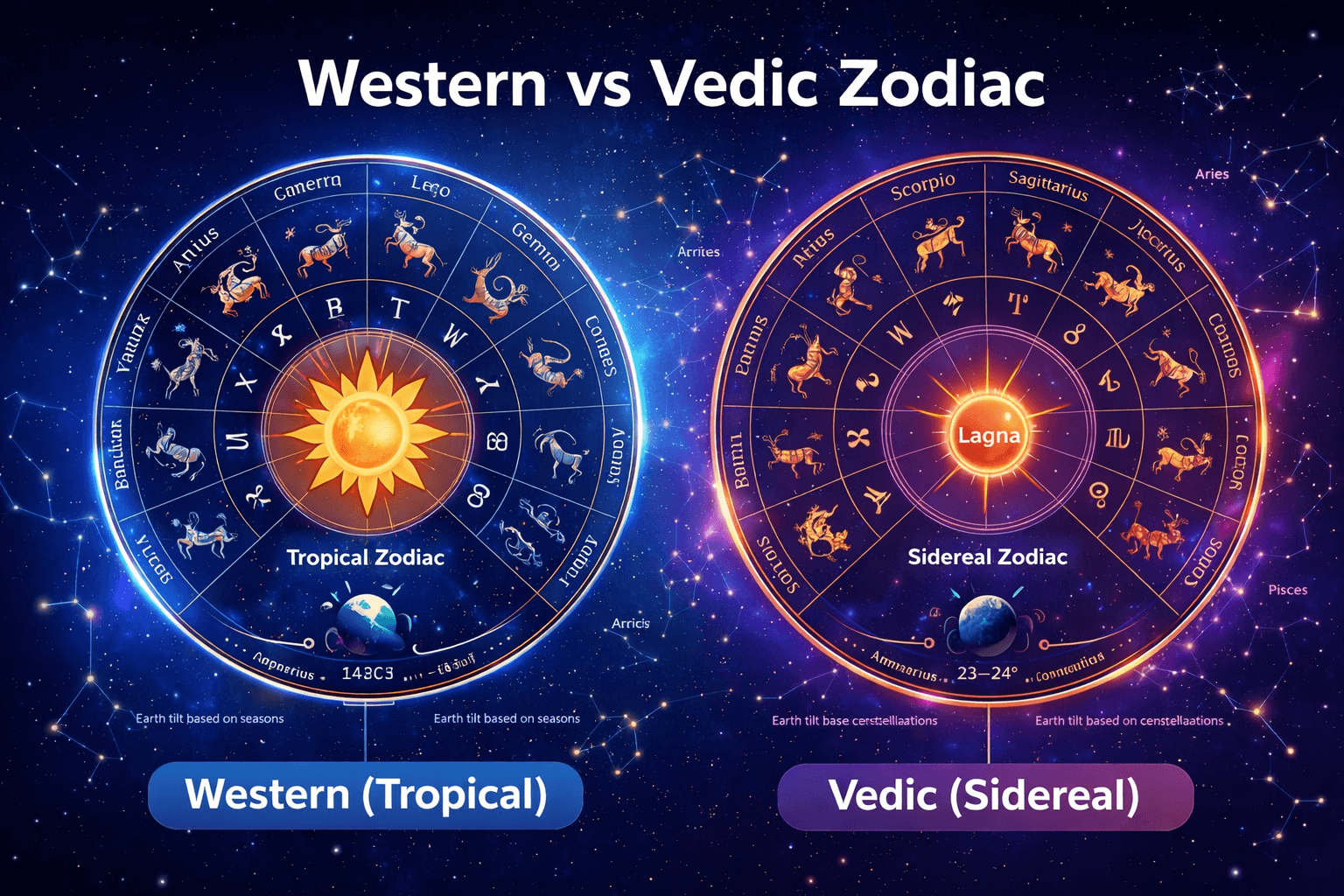
Many people are surprised to learn that their zodiac sign in Vedic astrology may be different from the one they know from Western astrology. For example, someone born on April 5 is usually considered Aries in Western astrology, but according to Vedic astrology that same person may actually belong to Pisces (Meena).
This difference often creates confusion among people who are exploring astrology for the first time. However, the explanation lies in the fact that Western astrology and Vedic astrology use two different systems for measuring the zodiac.
Understanding this difference helps clarify why zodiac dates vary and why Vedic astrology often assigns a different sign to the same birth date.
Two Different Zodiac Systems
The primary reason for the difference between Western and Vedic zodiac signs is the use of two different zodiac frameworks.
Western Astrology – Tropical Zodiac
Western astrology uses what is called the tropical zodiac. This system is tied to the Earth's seasons rather than the actual positions of constellations in the sky.
In the tropical zodiac, the zodiac begins with Aries at the spring equinox, which usually occurs around March 21 each year. Because this system is linked to seasonal cycles, the zodiac dates remain fixed year after year.
For example:
- Aries always begins around March 21
- Taurus begins around April 20
- Gemini begins around May 21
This system is widely used in modern Western horoscopes, newspapers, and astrology columns.
Vedic Astrology – Sidereal Zodiac
Vedic astrology, also known as Jyotish, uses the sidereal zodiac.
Unlike the tropical zodiac, the sidereal zodiac is aligned with the actual constellations in the sky. This means that Vedic astrology attempts to reflect the real astronomical positions of stars and planetary bodies.
Because of this astronomical alignment, the zodiac signs in Vedic astrology occur approximately 23–24 degrees later than the tropical zodiac.
This shift is why the zodiac dates differ between the two systems.
The Role of Axial Precession
The reason the tropical and sidereal zodiacs differ lies in a phenomenon known as axial precession.
The Earth does not rotate perfectly upright. Instead, its axis slowly wobbles over time, similar to the motion of a spinning top. This gradual shift causes the position of constellations to change relative to the seasons.
This movement occurs very slowly—about 1 degree every 72 years. Over thousands of years, however, the difference becomes significant.
When Western astrology established its zodiac system over 2,000 years ago, the tropical zodiac and the constellations were closely aligned. Since then, the Earth's axial precession has caused the tropical zodiac to drift away from the constellations.
Today the difference between the two systems is about 23–24 degrees.
Ayanamsa: The Correction Used in Vedic Astrology
Vedic astrology corrects this difference using a value known as Ayanamsa.
Ayanamsa represents the angular difference between the tropical zodiac and the sidereal zodiac. By applying this correction, Vedic astrologers align planetary positions with the actual constellations.
Several different Ayanamsa systems exist, but the Lahiri Ayanamsa is the most widely used in modern Indian astrology.
Using Ayanamsa ensures that Vedic astrology calculations correspond more closely with the real positions of celestial bodies.
Sankranti: How Zodiac Signs Begin in Vedic Astrology
Another important concept in Vedic astrology is Sankranti.
Sankranti refers to the moment when the Sun enters a new zodiac sign. Each Sankranti marks the beginning of a new solar month in the traditional Hindu calendar.
For example:
- Mesha Sankranti – Sun enters Aries
- Vrishabha Sankranti – Sun enters Taurus
- Makara Sankranti – Sun enters Capricorn
Because Sankranti is determined by the Sun’s exact astronomical position, the date can shift slightly each year by a few hours.
This is why Vedic zodiac dates are often described as approximate ranges rather than fixed dates.
Western vs Vedic Zodiac Date Comparison
Below is an approximate comparison between Western zodiac dates and Vedic zodiac dates.
| Zodiac Sign | Western Astrology | Vedic Astrology (Approx) |
|---|---|---|
| Aries | Mar 21 – Apr 19 | Apr 14 – May 14 |
| Taurus | Apr 20 – May 20 | May 15 – Jun 14 |
| Gemini | May 21 – Jun 20 | Jun 15 – Jul 16 |
| Cancer | Jun 21 – Jul 22 | Jul 16 – Aug 16 |
| Leo | Jul 23 – Aug 22 | Aug 16 – Sep 16 |
| Virgo | Aug 23 – Sep 22 | Sep 16 – Oct 17 |
| Libra | Sep 23 – Oct 22 | Oct 17 – Nov 16 |
| Scorpio | Oct 23 – Nov 21 | Nov 16 – Dec 16 |
| Sagittarius | Nov 22 – Dec 21 | Dec 16 – Jan 14 |
| Capricorn | Dec 22 – Jan 19 | Jan 14 – Feb 13 |
| Aquarius | Jan 20 – Feb 18 | Feb 13 – Mar 14 |
| Pisces | Feb 19 – Mar 20 | Mar 14 – Apr 13 |
Because of this shift, many people find that their Vedic zodiac sign is one sign earlier than their Western zodiac sign.
Example of the Zodiac Shift
Consider someone born on April 5.
In Western astrology, the Sun is already in Aries at this time. Therefore the person is classified as an Aries.
However, in Vedic astrology the Sun does not enter Aries until around April 14 (Mesha Sankranti). This means that on April 5 the Sun is still in Pisces.
As a result, the same person would be considered Pisces (Meena) in Vedic astrology.
This example illustrates how the shift between the tropical and sidereal zodiacs affects zodiac sign assignments.
Sun Sign vs Moon Sign in Vedic Astrology
Another major difference between Western and Vedic astrology is the importance given to different planetary placements.
Western astrology usually focuses primarily on the Sun sign, which represents core personality traits and identity.
Vedic astrology, however, places greater emphasis on the Moon sign (Rashi).
The Moon sign represents the emotional mind and psychological tendencies. Many predictive techniques in Jyotish—such as planetary periods and transits—are interpreted based on the Moon sign.
Therefore, even if someone knows their Sun sign, their Moon sign may play a more important role in Vedic astrology predictions.
The Importance of Ascendant (Lagna)
In addition to the Moon sign, Vedic astrology also places great importance on the Ascendant, known as Lagna.
The Ascendant is the zodiac sign rising on the eastern horizon at the exact moment of birth. It changes approximately every two hours.
The Lagna influences:
- physical appearance
- personality traits
- life direction
- how a person interacts with the world
Because the Ascendant changes quickly, an accurate birth time is necessary to calculate it correctly.
Nakshatras: The Lunar Constellations
One of the most unique aspects of Vedic astrology is the system of Nakshatras, or lunar constellations.
The zodiac is divided into 27 Nakshatras, each spanning 13 degrees and 20 minutes of the zodiac.
The Moon travels through these Nakshatras during its monthly cycle, spending roughly one day in each.
Nakshatras provide deeper insights into:
- personality traits
- spiritual tendencies
- karmic patterns
- compatibility between individuals
Because of this detailed system, Vedic astrology offers a more layered interpretation of a birth chart.
Why Western Astrology Became So Popular
Western astrology became widely known around the world primarily through media and popular culture.
In the 20th century, newspapers began publishing daily horoscope columns based on Sun signs. This simplified version of astrology made it easy for people to identify with their zodiac sign without needing detailed birth information.
As a result, Sun sign astrology became extremely popular.
However, professional astrologers in both Western and Vedic traditions typically use much more detailed birth chart analysis.
Which System Is More Accurate?
Both Western and Vedic astrology have their own philosophical frameworks and traditions.
Western astrology emphasizes psychological interpretation and seasonal symbolism.
Vedic astrology focuses more on astronomical alignment, planetary cycles, and predictive techniques.
Because Vedic astrology aligns with the actual constellations and includes additional tools such as Nakshatras and planetary periods, many practitioners consider it a more detailed and comprehensive system.
Final Thoughts
Understanding the difference between Western and Vedic zodiac systems helps explain why astrology interpretations can vary between traditions.
Western astrology uses the tropical zodiac tied to seasonal cycles, while Vedic astrology uses the sidereal zodiac aligned with the stars.
Because of this difference, zodiac dates shift by about 23–24 degrees, often changing a person's zodiac sign when calculated using the Vedic system.
To determine your true Vedic zodiac placements—including your Moon sign and Ascendant—an astrologer must calculate your complete birth chart using your date, time, and place of birth.
Want to know your true Vedic zodiac sign, Moon sign, and Ascendant?
Book a personalized birth chart reading with Astro Sanjiv.
Book Online Consultation